

8 Common Matcha Whisking Mistakes and How to Fix Them
Matcha is stubborn in a very specific way. The same tin can give you a thick, sweet, jade-green bowl on Tuesday and a bitter, clumpy, faintly grey cup on Wednesday. The leaf barely changed. What changed was heat, air, and the way you moved the whisk.
Nearly every disappointing bowl comes down to one of eight habits, and all eight are fixable in under a minute. Work through them in order — the first few cause the biggest problems.
Mistake 1: Water That's Too Hot
Boiling water scorches matcha. Push past roughly 80°C (175°F) and the powder turns bitter and astringent, the sweet marine notes disappear, and the fine particles fuse into clumps that no amount of whisking will break. It smells cooked, like green tea forgotten on a hotplate.
The fix: boil the kettle, then wait. Three to four minutes off the heat usually lands you between 70°C and 80°C (160–175°F), the sweet spot for a standard bowl of usucha. No thermometer? Pour the just-boiled water into your cold measuring cup, then into another cup, then into the bowl. Each transfer drops the temperature noticeably. If your matcha still tastes sharp at that range, go five degrees cooler. Good matcha gets sweeter as the water cools, not weaker.
Mistakes 2 and 3: Too Little Water, and Water That's Too Cool
Under-watering is the quiet cause of "why is my matcha so intense?" A thick paste gives the whisk nothing to move through: the tines drag, clumps survive, and the drink finishes harsh and drying. Aim for about one level teaspoon (roughly 2 g) of matcha to 60–90 ml (2–3 oz) of water. A heaped spoon in a small cup is a concentrate, not a bowl of tea.
Cold water fails in the opposite direction. Below about 60°C (140°F) the powder refuses to disperse. It floats in a dusty film, foam never builds, and the cup tastes flat and chalky no matter how long you whisk.
Quick diagnosis
- Bitter and sharp: water too hot.
- Chalky, no foam: water too cool, or too little of it.
- Overwhelming and drying: too much powder for the water you used.
Mistake 4: Skipping the Sift
Matcha is milled finer than talc, and it settles under its own weight in the tin. Those soft lumps are compressed powder. Drop one into the bowl and the outside wets instantly while the inside stays dry — a small stone of bitterness that survives the whisk and sinks to the bottom of your cup.
Sifting takes fifteen seconds and solves it completely:
- Set a small fine-mesh strainer over your bowl.
- Add the measured matcha.
- Tap the rim and press gently with the back of a spoon. Don't mash — you're separating, not crushing.
- Lift the strainer. You should see a pale green snowdrift with no visible lumps.
No strainer? Whisk the dry powder with a small fork in a cup for thirty seconds, or shake it in a lidded jar. Less elegant, still effective.
Mistake 5: The Wrong Whisk, and the Wrong Bowl
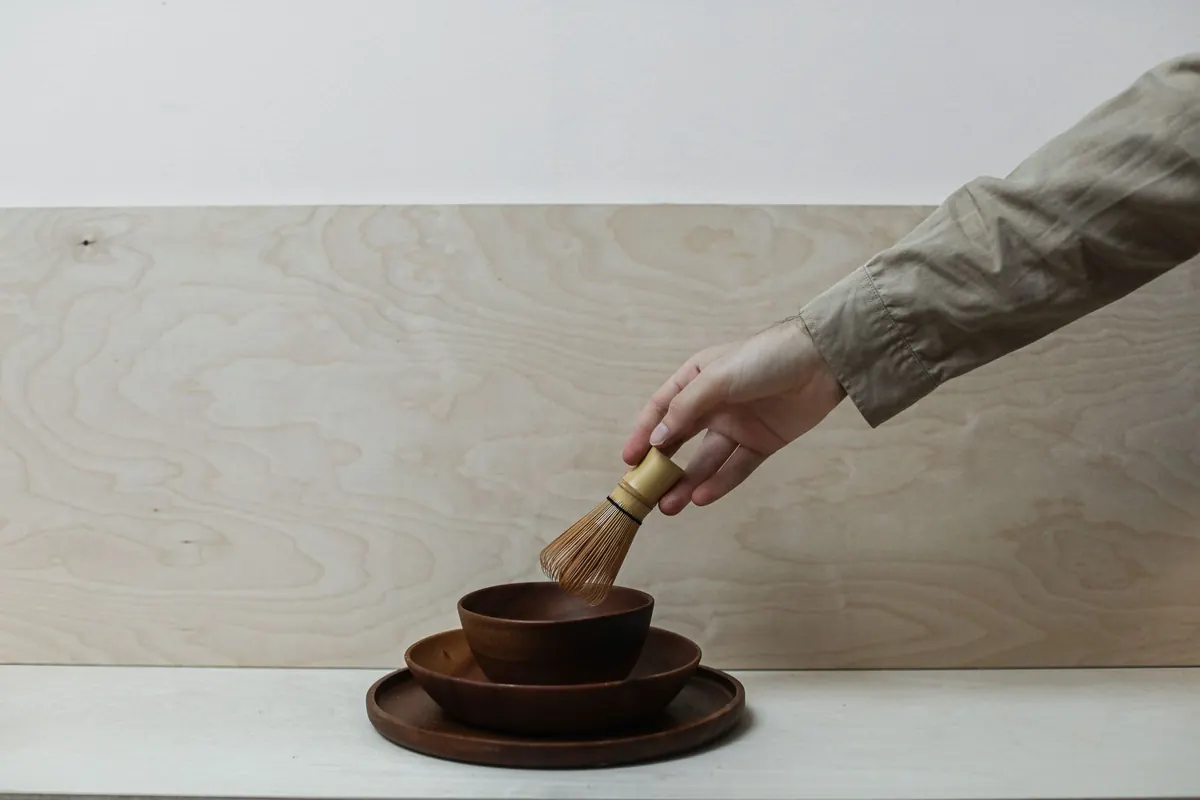
A metal balloon whisk, a fork, or a milk frother will all "work" and all give you the wrong texture. Electric frothers whip in big bubbles that collapse into a thin, soapy foam. Metal tines scrape the bowl and crush powder against the sides. A bamboo chasen with fine, closely set prongs — 80 to 100 of them — is built to shear water and powder into microfoam.
The bowl matters too. A narrow mug traps the whisk and sends water over the rim; a wide shallow dish lets everything slosh. You want something broad enough to move in and deep enough to whisk fast without splashing. A wide tea bowl, about 12 cm across, is the classic answer for good reason.
Mistake 6: Whisking in Circles
Stirring in circles moves liquid around. It doesn't fold in air, and it pools the powder in the middle. Real matcha whisking is a fast zigzag: hold the bowl steady, keep the whisk vertical, and move it back and forth in a tight "W" or "M" across the bowl, changing direction every second or so. A loose wrist at three or four strokes per second, for 15 to 25 seconds, is what turns a flat green puddle into dense, fine foam.
Watch your grip while you do it. A death-grip on the chasen locks the wrist and turns the motion into a stiff paddle. Hold the handle lightly, near the top, as if you were holding a pen you didn't want to drop. The movement should come from your fingers and wrist, not your shoulder.
Mistakes 7 and 8: Grinding the Bottom, and Quitting Too Soon
Two habits undo otherwise good technique. The first is pressing the whisk down until the tines scrape the floor of the bowl. That splays the prongs, wears out the bamboo, whips up large bubbles, and leaves a gritty layer you can feel on your tongue. Keep the tips just above the bottom — close enough to gather powder, never grinding against the ceramic.
The second is quitting too soon. Foam is built, not summoned. Most people stop at the first sign of green froth, roughly ten seconds in, and pour a drink with a thin bubble film that vanishes before they sit down. Keep whisking for another ten to fifteen seconds, slowing near the end and lifting the whisk through the centre to gather a soft peak. The difference between a decent bowl and a truly good one is often just those last few seconds.
The Whole Bowl, Start to Finish
Once the eight fixes become habit, the sequence is short and unreasonably satisfying:
- Boil, then wait three to four minutes for the water to fall to 70–80°C.
- Sift one level teaspoon (about 2 g) of matcha into a wide bowl.
- Add 60–90 ml of that water, pouring gently so you don't blast the powder up the sides.
- Whisk in a tight W or M, tips just off the bottom, for 15 to 25 seconds.
- Slow, lift, and drink — ideally within a minute or two, before the foam settles.
Thirty seconds of work for a bowl that tastes nothing like the clumpy version you started with.
If You've Already Ruined the Bowl
Not every mistake is fatal. If your matcha is bitter because the water was too hot, you can't un-brew it, but you can pour the bowl over ice with a splash of cold milk or oat milk — cold, sweet, and fat all round off the scorched edges beautifully. If it's chalky from cool water, add a tablespoon of hot (not boiling) water and whisk again; the powder will usually disperse on the second pass.
Clumps that survive the whisk are the one thing worth fixing at the source. Pour the whole bowl through a fine strainer into a second cup, pressing the solids through with the back of a spoon, then whisk the strained liquid again. It's an extra step, but it beats drinking grit.
Keeping the chasen alive
A bamboo whisk is a tool with a lifespan, and a few small habits stretch it from months to years. Rinse it under warm running water immediately after use — never soap, never the dishwasher — and stand it on its handle so the tines dry without touching anything. Before each use, dip the tips in hot water for a few seconds to soften the bamboo; dry prongs snap, and once a few tines break off, the whisk can't build fine foam. Store it somewhere it won't get crushed, and it will outlast several tins of matcha.
None of this is fussy. It's just the difference between treating matcha like instant coffee and treating it like what it is — a very fine powder that responds to heat, water and motion with almost absurd sensitivity. Get those three right, and the leaf does the rest.
Photo: Cup of Couple / Pexels